More personal instruction, more opportunities to practice, and less pressure can make all the difference when you’re learning pickleball.
There’s a big difference between being around pickleball and actually learning how to play it.
A new player can watch games, pick up a paddle, hit a few balls with friends and even join an open-play session. But when she doesn’t understand why the ball keeps going into the net, where she should stand, when she should move forward or how the scoring works, enthusiasm can quickly turn into frustration.
For a true beginner, the problem usually isn’t ability.
It’s that she needs instruction—and enough individual attention to understand what she’s doing.
That’s one of the reasons Rebecca Boyce believes small-group pickleball lessons can be such an effective way for women to learn the game.
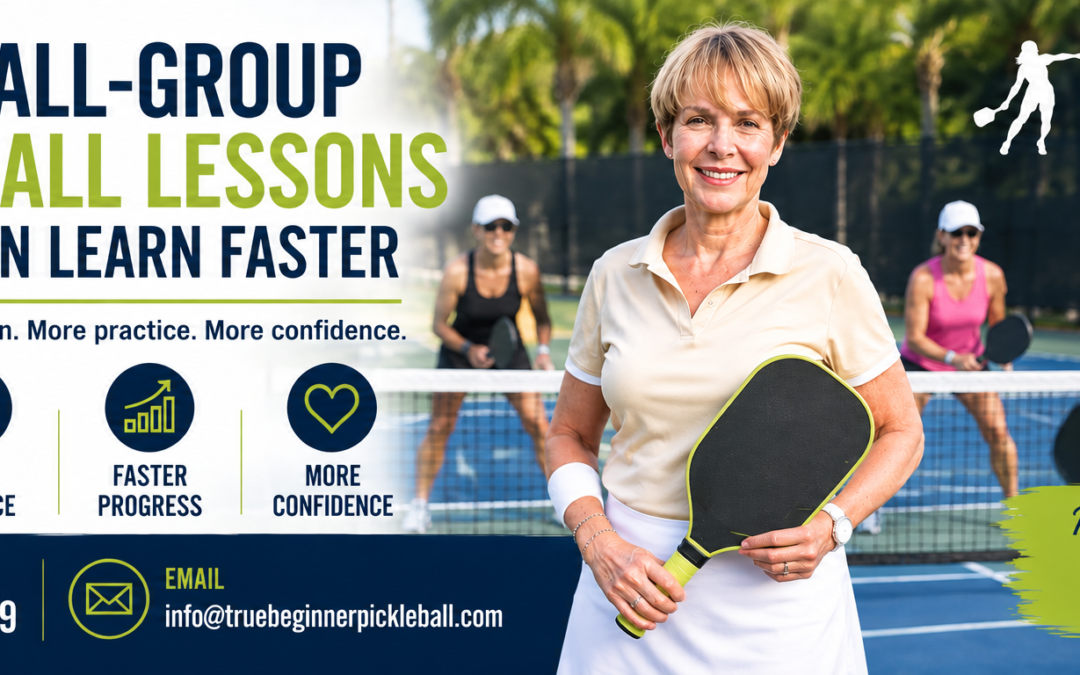
At True Beginner Pickleball for Women, the goal isn’t simply to put a group of people on a court and start hitting balls. Lessons are designed to create an environment where beginners can ask questions, receive feedback, practice repeatedly and gradually become comfortable playing the game.
Because when you’re learning something completely new, being seen by your instructor matters.
Beginners Need More Than Instructions
Imagine being told how to serve.
You listen to the explanation. You watch the demonstration. Everything makes sense.
Then you try it.
The ball goes into the net.
You try again.
This time it goes sideways.
What happened?
That’s where instruction becomes coaching.
A good instructor can notice the small things a beginner doesn’t yet recognize: paddle position, contact point, body position, grip, timing or follow-through.
In a small group, Rebecca has more opportunities to observe those details and make corrections while the student is actually learning the movement.
Instead of repeatedly practicing the same mistake, the student can make an adjustment and try again.
That feedback loop—try, observe, adjust, repeat—is one of the most important parts of learning pickleball.
More Touches Mean More Learning
Beginners need to hit the ball.
A lot.
Watching someone else practice has value, but it doesn’t replace feeling the paddle make contact with the ball yourself.
Small-group instruction can create more opportunities for purposeful repetition.
A student can practice a forehand again.
And again.
And again.
She begins recognizing what good contact feels like.
Then she starts developing consistency.
The same principle applies to serving, returning, dinking and other fundamental skills.
Those repetitions aren’t about perfection. They’re helping the brain and body become familiar with movements that initially feel completely new.
Eventually, something that required a great deal of concentration begins to feel more natural.
That’s progress.
There’s More Room to Ask Questions
Beginners have questions.
Lots of them.
Where should I stand?
Whose serve is it?
Why can’t I volley from here?
When should I move toward the kitchen?
Wait—what’s the score again?
Those questions shouldn’t be embarrassing. They’re part of learning the game.
In a smaller class, there’s room for conversation.
Rebecca can explain not only what a player should do but also why she should do it.
That distinction becomes increasingly important as students progress.
Memorizing where to stand might get someone through a drill. Understanding why she’s standing there helps her eventually make decisions for herself during a game.
Pickleball Is About Positioning, Not Just Hitting
One of the surprises for many new players is discovering that pickleball isn’t simply about hitting the ball back over the net.
Where you stand matters.
When you move matters.
Where your partner is standing matters.
The non-volley zone—the “kitchen”—introduces another layer that may initially seem unfamiliar.
In doubles, beginners also need to become aware of spacing, movement and communication with their partners.
These concepts are easier to understand when an instructor can stop the action and explain what’s happening.
Rebecca might reposition a student by a few feet and suddenly the court makes more sense.
Those little moments are difficult to replicate by simply watching videos or jumping into recreational games.
Small Groups Can Feel Less Intimidating
There’s also an emotional side to learning.
A woman trying pickleball for the first time may already be wondering whether she’ll be good at it.
Put her into a large group filled with players at different levels, and she may become more concerned about keeping up than actually learning.
A small group of beginners changes the dynamic.
Everyone misses.
Everyone asks questions.
Everyone forgets the score occasionally.
And everyone experiences those exciting little breakthroughs.
Instead of feeling like the person who doesn’t know how to play, you’re simply one of several women learning together.
That can take a tremendous amount of pressure off the experience.
You Still Get the Social Side of Pickleball
Private instruction can be valuable, but learning in a small group provides something else that’s important to pickleball: other people.
Pickleball is inherently social.
Learning with other women gives students opportunities to practice with different partners, communicate on the court and begin experiencing the cooperative side of doubles play.
It also creates connections.
The woman standing beside you during your first lesson may eventually become someone you call when you want to practice.
That’s one of the beautiful things about learning in a group.
You’re developing your game while simultaneously beginning to build your pickleball community.
Mistakes Become Part of the Lesson
Nobody likes making mistakes in front of other people.
But something interesting happens when you’re surrounded by other beginners.
You realize everyone is making them.
One ball goes into the net.
Another goes long.
Someone forgets the score.
Everyone laughs, resets and tries again.
That helps redefine mistakes.
They’re no longer evidence that you’re “bad at pickleball.”
They’re information.
Why did the ball go long?
What could you change?
Try again.
That mindset can dramatically change the beginner experience.
Four Weeks Gives Skills Time to Develop
True Beginner Pickleball uses structured four-week sessions because learning doesn’t happen all at once.
The first lesson introduces concepts.
The next lesson reinforces them.
Then students begin combining skills.
Over time, the unfamiliar starts becoming familiar.
A woman who spent her first class concentrating intensely just to make contact with the ball may eventually find herself thinking about placement, positioning and strategy.
That’s why consistency matters.
Progress doesn’t always arrive as one dramatic breakthrough. More often, it’s a collection of small improvements that become noticeable when you look back at where you started.
The Goal Is Independence
Good beginner instruction shouldn’t make a student dependent on her instructor forever.
It should prepare her to play.
The real milestone comes when a woman understands enough of the fundamentals to step onto a court, join other players and enjoy herself without constantly wondering what she’s supposed to do.
She understands the basic scoring.
She can serve.
She knows where to position herself.
She can participate in a rally.
She understands the kitchen.
And when she makes a mistake, she doesn’t panic.
She simply gets ready for the next ball.
That’s confidence.
Small Class. Big Difference.
Learning pickleball doesn’t need to feel overwhelming.
With personal attention, repetition, encouragement and other beginners learning beside you, the process can become one of the most enjoyable parts of the sport.
You don’t need to arrive knowing how to play.
That’s the whole point.
At True Beginner Pickleball for Women, Rebecca Boyce helps women build their game from the fundamentals up—one lesson, one correction and one successful shot at a time.
Because sometimes the fastest way to become part of a very big pickleball community is to start in a very small group.
Ready to Learn Pickleball?
If you’ve been wanting to try pickleball but aren’t comfortable jumping into a game without learning the fundamentals first, True Beginner Pickleball for Women was created for you.
Call or Text: 305-606-6939
Email: info@truebeginnerpickleball.com
Real Instruction. Real Support. Real Results.
FAQ
Are small-group pickleball lessons good for complete beginners?
Yes. Small groups can be particularly helpful for beginners because students receive instruction while still having other players available for drills, partner work and game situations.
Do I need to know the rules before starting?
No. A true beginner program should teach the fundamentals of the game, including basic rules, scoring, positioning and court terminology.
What will I learn in beginner pickleball lessons?
Lessons may include paddle fundamentals, serving, returning, forehands, backhands, dinking, court positioning, scoring, doubles movement and introductory strategy.
What if I’m not athletic?
You don’t need an athletic background to begin learning pickleball. Skills such as coordination, movement and paddle control can develop through instruction and practice.
How long is the True Beginner Pickleball program?
True Beginner Pickleball offers structured four-week sessions, giving students time to practice and reinforce what they’re learning.